
In the PCB assembly process, solder paste vs flux are indispensable, playing a critical role in attaching components to the board. Sometimes, electronic hobbyists, students, or even some engineers may confuse them. Thus, understanding the differences between solder paste vs flux and how they assist in forming reliable solder joints is essential.
What Are Solder Paste and Flux?
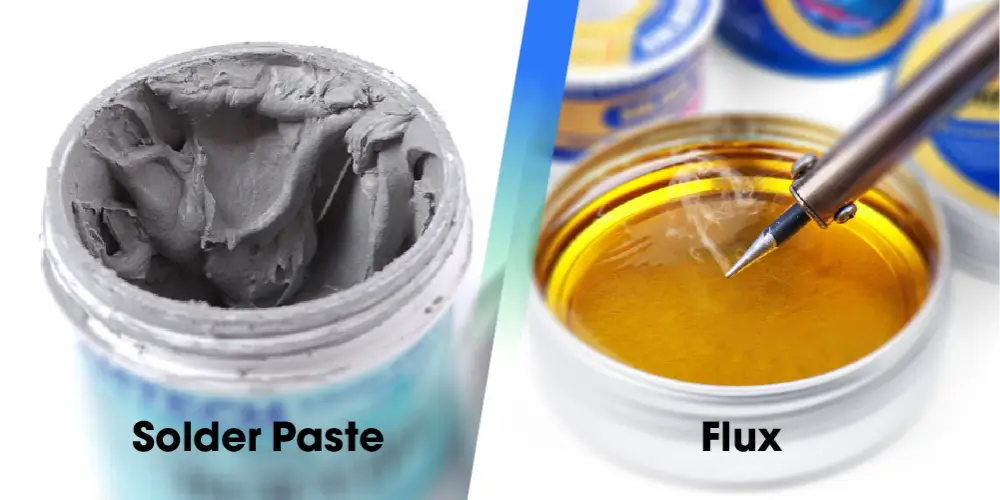
Solder paste is made of flux and powdered solder alloy, resulting in a paste style. It’s available in leaded and lead-free options and can form dependable solder connections. However, flux alone can not help form solder joints, which is only a kind of chemical cleaning compound. It can remove oxides or prevent oxide formation, highly assisting in the formation of a strong metallurgical bond by molten solder. Therefore, solder paste vs flux are significantly different but related.
Solder Paste vs Flux: What Are the Key Differences?
Now that you have a basic understanding of solder paste vs flux, let’s take a closer look at how they differ. This comparison will help you gain a clearer understanding of them and eliminate any previous confusion.
1. Composition
Solder paste composition
- Leaded Solder Paste– Sn63/Pb37 (63% tin, 37% lead) and flux.
- Lead-Free Paste– SAC305 (96.5% tin, 3% silver, 0.5% copper) and flux.
Flux paste composition
- Resin– Serves as the base material with high thermal stability, low volatility, non-conductive, and non-corrosive properties.
- Activators– Commonly use organic acids or amine halides to enhance the cleaning ability. They can be activated under high soldering temperatures to chemically disrupt or dissolve metal oxides.
- Solvents and Binder– Use to adjust the viscosity and make the flux more spreadable, ensuring proper adherence to the pads before heating.
- Additives– Add to improve performance, such as enhancing stability, controlling residue, or improving cleanability.
2. Physical Form and Color
With high metal content, solder paste looks gray and similar to putty. Due to the thick paste property, it can hold the components on the board for later soldering. Flux is usually yellowish-white or transparent, and can be in liquid, paste, or solid types. It can be sold in bottles, syringes, jars, or convenient flux pens, depending on the application method.
3. Solder Paste vs Flux: What Function Do They Serve?
Key Functions of Solder Paste
- Provides a medium for component adhesion.
- Acts as a temporary adhesive to hold components in place.
- Ensures good wetting and adhesion of solder joints.
Key Functions of Flux
- Removes oxides from the surfaces of the metals to be soldered.
- Facilitatesthe flow of molten solder and enhances adhesion.
- Prevents the formationof new oxides during
4. Solder Paste vs Flux: Type Differences
Types of Solder Paste: Categorized by Particle Size
Smaller particle sizes allow for finer pitch printing and better solder joint precision. As the type number increases, the solder particle size becomes smaller.

- Type 1 – 150–75 µm
- Type 2 – 75–45 µm
- Type 3 – 45–25 µm, a standard choice for most SMT applications
- Type 4 – 38–20 µm, ideal for fine-pitch components
- Type 5 – 25–10 µm, used for ultra-fine-pitch components
- Type 6 – 15–5 µm
- Type 7 – 11–2 µm
- Type 8 – 8–2 µm
Types of flux paste
Each flux has different properties, and the selection needs to take into account assembly requirements. Below are the three common flux types:
- Traditional rosin flux – It’s the most essential type derived from rosin, which is non-corrosive and insulating. For the majority of electronics, rosin flux is safe, particularly when using lead-free solder. It’s suitable for rework and hand soldering.
- Water–soluble flux – As the name suggests, this flux is made of water-soluble organic components, which makes the later cleaning easier. It can efficiently remove oxides and is frequently used in high-reliability uses, but it needs to be carefully cleaned after use to avoid corrosion.
- No-clean flux – This flux is designed to leave as little residue as possible, so that the following cleaning is not needed. It is widely used in the assembly of consumer electronics, such as smartphones, laptops, etc.
5. Application Methods
There are two main methods to apply solder paste: dispensing and stencil printing. Dispensing is a relatively simple technique, using a dispensing applicator or similar tool to apply solder paste precisely to the designated locations on the board. Also, an automatic dispenser can be used. This method is suitable for prototyping or small batch manufacturing. Stencil printing uses a PCB stencil with openings corresponding to the PCB pads to deposit solder paste to specific areas. It’s ideal for large volume production and fine pitch SMT components.

With flux, it’s easy to apply. You can use a flux pen, syringe, or brush to apply a thin, uniform layer of flux to the intended areas. Ensure complete coverage, but do not apply too much. Before soldering, just remember to remove the excess flux.
6. Storage and Service Life
Notice that solder paste is prone to deterioration. This is because solder paste contains flux, and the activators in the flux react slowly with the solder powder at room temperature. Therefore, the solder paste deteriorates over time. Commonly, solder paste needs to be refrigerated at 0-10°C, which also assists in extending the shelf life. Under proper storage conditions, most commercially available solder pastes have a service life of about 6 to 12 months.
Changes in temperature and time do not significantly affect flux. When sealed, flux can be kept at ambient temperature for 1-2 years. The flux core inside the solder wire is usually regarded as non-expiring, especially when stored in a sealed bag.
Flux Paste vs Solder Paste: A Simple Comparison
| Aspect | Solder Paste | Flux |
| Composition | Leaded or lead-free solder powder mixed with flux | Resin, activators, solvents , binder, and additives |
| Physical Form and Color | Gray, thick paste | Liquid, gel, paste, or solid |
| Main Function | Holds components, promotes wetting and adhesion, forms solder joints | Removes oxides, promotes solder flow, prevents oxidation |
| Storage and Service Life | Short shelf life, usually needs refrigeration | Longer shelf life, usually stored at room temperature |
| Types | Type 1 – 8 (various particle sizes) | Water soluble flux, rosin flux, no-clean flux |
| Clean Requirement | No-clean solder paste usually doesn’t require cleaning, other types may need residue removal | Often needs cleaning after use, except for no-clean flux |
| Application Methods | PCB stencils or dispensers | Brush, spray, dipping, or dispensing |
| Use Cases | Reflow soldering | Hand soldering or rework |
| Independent Use | Flux is already included in solder paste | Independent use in hand soldering or reflow support |
| Thermal Response | Melts to create solder joints | Activates at high temperatures |
How Solder Paste and Flux Work Together in the PCB Assembly Process
Solder paste vs flux work closely together during PCB assembly to ensure high soldering quality. Before soldering, the solder alloy in the solder paste holds the components to the pads. The flux removes oxides from the surfaces to be soldered and enhances solder wettability, preparing them for soldering.
The solder paste melts into a liquid state, forming solder joints during reflow soldering. As the temperature rises, the flux in the solder paste is activated, eliminating impurities and facilitating the flow of molten solder.
Both solder paste vs flux work together to ensure the reliability and strength of the solder joints, ultimately resulting in a high-quality PCBA.
Solder Flux vs Solder Paste: How They Affect Solder Joint Dependability
The strength, conductivity, and quality of solder joints directly affect the overall performance and service life of electronic devices. Solder paste vs flux play a crucial role in impacting the solder joints. Below are the key influence factors:
- Solder joint strength: Accurate solder paste application and controlled reflow technique can ensure higher solder joint strength. The flux can clean the surface, also assisting in forming robust connections.
- Solder jointconductivity: Proper use of solder paste can create uniform and stable solder joints, thus ensuring good conductivity. Flux further enhances the conductivity of solder joints by eliminating impurities and oxides.
- Solder jointquality: Reducing the voids in the solder joints results in a more stable quality and helps extend the service life. Flux can also reduce the risk of corrosion, thereby further extending the service life.
Last Words
Solder paste vs flux are both critical materials in the PCB assembly process, working together to acquire a good result. For professionals, it’s essential to understand their differences and proper applications to achieve reliable solder joints and consistent assembly quality. By selecting the right solder paste and flux, you can significantly improve overall manufacturing performance.
FAQs of Flux Paste vs Solder Paste
1. Is solder paste better than flux?
There is no superiority or inferiority between solder paste vs flux. They serve different functions and are complementary.
2. Can I use soldering paste as flux?
No. Solder paste cannot replace flux. Solder paste contains flux, but its primary purpose is to create solder joints during reflow. Flux alone is designed only to clean surfaces and improve wetting. If you use solder paste as flux, it will not flow or clean properly, leading to poor soldering joints.
3. Why is it necessary to refrigerate solder paste?
The flux in solder paste contains activators, which are highly active at high temperatures, but their activity slows down at low temperatures. Refrigeration can extend the lifespan of solder paste.
4. What happens if I don’t use flux when soldering?
Without flux, the metal will oxidize, preventing the formation of a solder joint, resulting in weak and unreliable solder connections.