
Lead solder has been the mainstream choice in PCB manufacturing for the past few decades due to its economical and low melting point. However, with increasing environmental and health awareness, people are becoming more concerned about the potential hazards of using lead solder. In 2006, the European Union officially implemented regulations restricting the use of specific hazardous substances (such as lead) in electronic products. Since then, the transition to lead-free solder has accelerated. Both lead solder vs lead-free solder serve the same function, securely bonding components to circuit boards, but they differ in several key aspects. The following blog provides a full comparison of them.
Lead Solder vs Lead-Free Solder: Key Differences
Alloy Composition
Leaded solder is also called SnPb solder, which means it is a eutectic metal alloy of tin (Sn) and lead (Pb), typically expressed as a ratio of 63/37 Sn/Pb. Lead-free solder is a metal alloy composed primarily of tin (Sn), with possible additions of silver (Ag), copper (Cu), antimony (Sb), bismuth (Bi), nickel (Ni), or zinc (Zn). Among these, tin-copper is the most commonly used combination, offering improved mechanical strength. Tin-silver provides better conductivity along with enhanced oxidation and corrosion resistance. Tin-zinc is a cost-effective option with a low melting point.
Melting Point
The melting point of lead solder ( 63/37 Sn/Pb) is 183 degrees Fahrenheit (approximately 84 degrees Celsius). It has a well-defined melting point, and this melting point is lower than that of other solders, making it less likely to damage components and easier to reach the required soldering temperature. Thus, leaded solder is beneficial for PCB assembly and causes less thermal damage to the circuit board.
Compared with leaded solder, lead free solder commonly has a higher melting point, which varies with alloy composition, ranging from 50°C to higher than 200°C. The melting point rises with increasing tin concentration. The higher melting point is one of the reasons why its solder joints oxidize faster than those of lead solder.
Key Material and Performance Differences Between Lead Solder vs Lead-Free Solder
- Corrosion resistance:Lead-free solder has higher corrosion resistance.
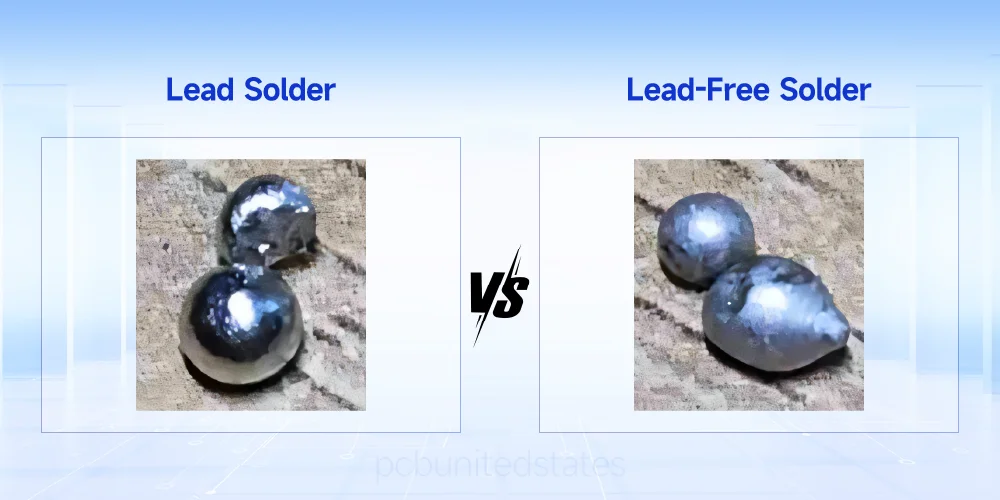
- Physical features & appearance: Lead solder is softer than lead-free solder and typically forms smoother and shinier solder joints.
- Mechanical strength (shear): Lead-free solder forms joints with higher shear strength compared to leaded solder (27 vs 23 MPa, respectively).
- Solderability (wettability): Compared with leaded solder, lead-free solder exhibits higher surface tension (548 vs 481 mN/m) and lower wettability, typically requiring about 2% (by mass) flux addition.
- Electrical properties: Compared with lead-free solder, leaded solder shows lower electrical conductivity (11.5% vs 15.6% IACS) and higher electrical resistivity (15 vs 11 MΩ·cm).
- Thermal conductivity: Lead-free solder provides better heat transfer performance compared to leaded solder (73 vs 50 W/mK, respectively).
- Coefficient of Thermal Expansion(CTE): Leaded solder has a higher CTE than lead-free solder (23.9 vs 21.4 µm/m°C, respectively).
- Fatigue life: Leaded solder generally offers better fatigue performance, about three times greater in relative terms.
- Density: Leaded solder is denser than lead-free solder (8.5 vs 7.44 g/cm³, respectively).
Health, Safety & Environmental Impact
Electronic products using lead solder can cause serious environmental damage, including polluting the air, soil, and water. During soldering or subsequent repairs, lead can enter the air in the form of dust or fumes, which then settle into the surrounding environment. Once lead dust enters the soil, it is difficult to degrade naturally. And long-term accumulation can alter the soil composition. Lead solder in discarded electronic products can slowly leach into groundwater, rivers, or lakes in humid environments.
Lead has a direct impact on the nervous system, blood system, and internal organs, and is difficult to metabolize and eliminate from the body. Short-term exposure to lead can cause a range of health symptoms (e.g, headaches, abdominal pain, memory loss), which are often early warning signs of physical harm. Prolonged exposure to or contact with high concentrations of lead can even lead to brain damage or death.
In contrast, lead free solder eliminates lead as a source of contamination, significantly minimizing environmental and health risks throughout manufacturing, use, and end-of-life disposal.
Cost Comparison Between Lead Solder vs Lead-Free Solder
Increased solder costs directly impact the overall cost of PCBs. The cost difference between lead solder vs lead free solder is significant. Lead solder is more economical. At the same time, it is typically made from tin alloyed with copper, silver, or other metals. These metals are far more expensive than lead, significantly increasing the overall cost of lead-free solder.
| Aspect | Leaded Solder | Lead-Free Solder |
| Main Components | Sn/Pb 63/37 | Sn, Ag, Cu, Sb, Bi, Ni, or Zn |
| Melting point | 183 °C | 217-220 °C (typical SAC alloy), depending on alloy composition |
| Solder joint appearance | Smoother, brighter | Slightly duller, rougher |
| Solder Wetting / Wettability | Good | Poor, ~2% flux needed |
| Process Requirements | Standard soldering temperature | Higher temperature required, more flux |
| Cost | More cost-efficient | Slightly higher cost |
| Health & Safety | Toxic, not RoHS compliant | Safer, RoHS compliant |
| Common Applications | Legacy electronics, cost-sensitive products | Consumer electronics, environmentally regulated markets |
| Availability / Supply | Widely available | Increasingly common, may vary by alloy type |
Lead and Lead-Free Solder: Which One is Better to Use?
This is indeed a controversial selection. Actually, it’s inaccurate to definitively state which type of solder (lead solder vs lead-free solder) is better. Due to its good performance and price advantages, lead solder has been the preferred option in the electronics manufacturing industry for decades. Thus, it is still used in some applications and industries today.
Compared to lead solder, lead-free solder is not as easy to use. The toxicity of lead and the restrictions imposed by relevant regulations are the main reasons why most PCB manufacturers are adopting lead-free soldering. In countries and regions that restrict the use of lead-containing electronic products (such as the United States and the European Union), PCB manufacturers are required to use lead-free solder. This is the only option.
In DIY projects, prototyping, or electronics repair, leaded solder remains a common choice for many engineers and electronics enthusiasts. Compared to lead-free solder, lead solder has a lower melting point and better wettability, making manual soldering easier to control. Of course, operators still need to pay attention to ventilation and safety to minimize health risks.
Wrap Up
Selecting lead solder vs lead-free solder is not merely a matter of performance. It also needs to consider compliance requirements, environmental influences, etc. Although leaded solder is still used in certain applications, the overall trend in the industry is clearly shifting towards lead-free solutions due to safety and sustainability concerns. By understanding the differences between lead free vs lead solder, PCB manufacturers can make more informed choices, balancing reliability, compliance, and manufacturing efficiency. At MOKOPCB, we always prioritize compliance and provide RoHS-compliant products. Contact us to get started on your next project!