
Soldering is the key step in the PCB assembly process, attaching components on the board to perform the intended function of PCBAs. The soldering quality significantly impacts the electronic products’ reliability and performance. Wave soldering vs reflow soldering are two commonly used methods. However, the differences between them remain confusing for many, and it is unclear when to use each technology. This is precisely the purpose of this blog post – to guide you through understanding the differences between wave soldering vs reflow soldering, and dispel any doubts you may have.
What Is Wave Soldering?
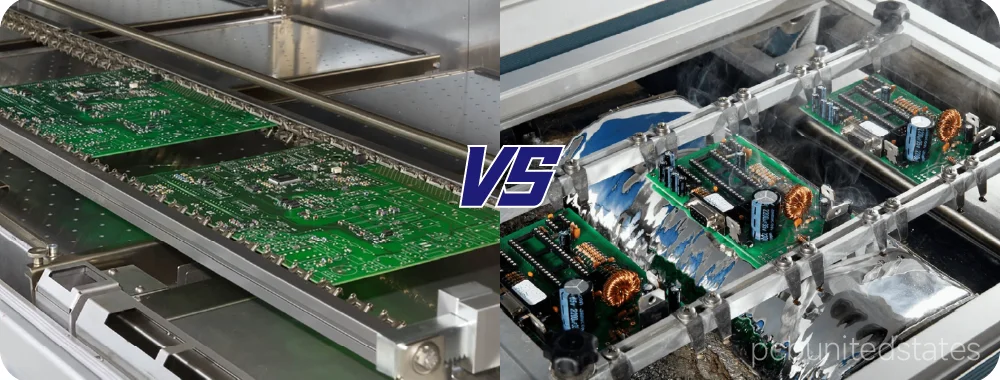
It is a kind of bulk soldering technique, generally used to solder THT components. Each PCB is sequentially sent through the tank with continuous recirculating molten solder. The pumped wave of solder contacts the bottom of the board, creating solder joints simultaneously.
Temperature control is crucial during wave soldering. Incorrect temperature may lead to soldering defects (cold solder joints, solder bridges, etc.) or even damage the components.
What Is Reflow Soldering?
It is commonly used to solder surface-mount components. The solder paste, a combination of flux and powdered solder, is applied to the corresponding pads to hold the components in place. Then, the board is sent into the reflow oven, where the solder paste is melted to create connections.
Sometimes, reflow soldering can be used to solder THT components, but this is rare because wave soldering is a more economical option.
How Do Wave Soldering vs Reflow Soldering Compare?
Since you’ve a basic understanding of wave soldering vs reflow soldering, let’s explore their difference to make a better decision.
1. Process Differences in Wave Soldering vs Reflow Soldering
Wave Soldering Process: Flux Application → Preheating → Wave Soldering → Cooling
Stage 1: Spray flux to clean metal surfaces. The flux’s important functions include:
- Remove the oxide or contamination residue on the component leads and PCB pads to improve solder wetting.
- Prevent re-oxidation during the thermal process.
- Lower the surface tension of molten solder to ensurethe solder flows
- Promote even and proper heat transfer.
Notice: Select a flux type that is fully compatible with your application, avoiding damage to components.
Stage 2: Preheat the boards to decrease the risks of thermal shock and activate the flux. The boards are placed on the pallet and conveyed into a heating tunnel via a conveyor belt.
Stage 3: Preheated boards are then sent through a continuous, pump-generated, and liquid wave of molten solder. The controlled pump wave contacts the pads and component leads to establish robust solder joints, typically lasting 1-5 seconds.
Notice: Temperature setup is critical, highly affecting the solder quality. Similarly, conveyor speed and wave contact time should also be considered carefully.
Stage 4: The temperature reaches the peak in the wave soldering process, then gradually decreases, which is called the cooling process. The liquid alloy solidifies to create strong mechanical connections.
Notice: A professional wave soldering machine is essential, while the assembler’s expertise relies on up-to-date technology and experience.
Reflow Soldering Process: Preheating → Thermal Soak → Reflow Soldering → Cooling
Stage 1: Preheat the boards for later soldering. The two primary purposes of this stage are:
- Remove volatile solvents from the solder pasteas they can reduce the solder junctions’ dependability.
- Ensure the boards can steadily reach the required temperature, adhering to the thermal profile.
Stage 2: Like wave soldering, reflow soldering also relies on flux. Requires thermal soak to reach a temperature sufficient to activate the flux.
Stage 3: The temperature reaches the peak, melting the solder to reflow correctly.
Notice: Temperature control is critical. The solder paste won’t reflow correctly if the temperature is too low. The circuit board or SMT components could be harmed by an excessively high temperature.
Stage 4: The temperature will gradually go down after the peak. Cooling to permanently connect the components to the pads.
2. Component Compatibility
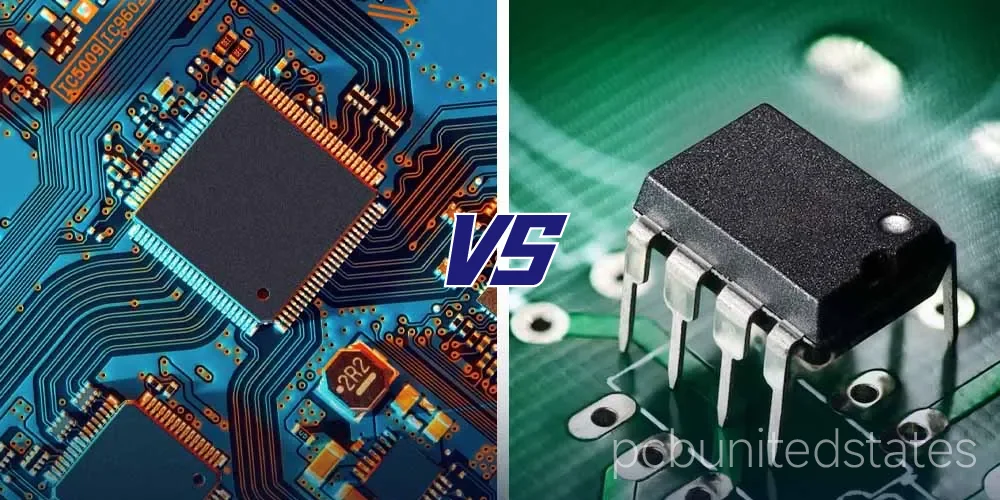
Wave soldering is suitable for THT components and can quickly complete the soldering simultaneously. It is commonly used to connect large electronic components, such as connectors, switches, etc. The component leads need to be inserted into pre-drilled holes on the boards, ultimately forming secure mechanical connections.
Reflow soldering is ideal for SMT components, which are typically small in size and have a small pitch. These small components (microprocessors, resistors, etc.) can be directly placed onto the surface of the board during the soldering process.
3. Common Applications of Wave Soldering vs Reflow Soldering
Wave soldering offers reliable and strong solder joints and remains widely used in many industries due to its simplicity and cost-effectiveness. It is commonly applied in power supplies, automotive electronics, large home appliances, etc.
Reflow soldering enables precise control over solder joint formation, playing a crucial role across various industries. It is widely used in consumer electronics, including smartphones, laptops, and tablets. For high-density PCBs, reflow soldering is also indispensable, especially for computers and telecommunications devices, ensuring reliable connections in compact boards.
In addition, reflow soldering supports emerging technologies and specialized applications, including: IoT devices (wearables and smart home gadgets), medical devices (diagnostic equipment and portable health monitors), and robotics (sensors and control systems).
4. Production Efficiency
Wave soldering is a continuous and high-throughput technique, ideal for high-volume production and through-hole component soldering. It is more economical and faster than reflow soldering. Moreover, after the PCB is soldered, the excess solder flows back into the furnace for reuse, reducing material waste.
Reflow soldering is limited by multiple processes, such as printing, placement, and reflow, which are usually time-consuming. Therefore, it’s not suitable for rapid production and is typically used in small-scale manufacturing.
5. Cost Comparison
Reflow soldering requires investment in a reflow oven (the core equipment), a pick-and-place machine, a solder paste printer, etc. These machines are complex and expensive, and maintenance costs are also high. For small PCB manufacturers, this means a very large initial investment. In contrast, a wave soldering machine is usually much cheaper than a reflow oven, so the initial setup costs are generally lower.
Wave Soldering vs Reflow Soldering Comparison Table
| Aspect | Wave Soldering | Reflow Soldering |
| Best for | Through-hole (THT) assembly, single-sided PCB assembly, edge-mounted connectors | Surface-mount (SMT) assembly, HDI board, Double sided SMT PCBs |
| Popularity | Declining in use over time, but dominant in THT | Highly preferred for SMT due to numerous advantages |
| Production Cost & Time | More cost-effective and time-efficient for high-volume through-hole production | Typically requires more time and higher costs, especially complex, high-mix SMT projects |
| Production Speed | Continuous and high-throughput, up to 35,000 solder joints per hour | Throughput limited by print, place, reflow sequence, typical throughput 2,500–6,000 joints/hour |
| Production Volume | Ideal for large-scale through-hole production | Best for small production or complex projects |
| Design Considerations | Demands precise pad geometry (size and shape) design and controlled board orientation | Fewer design constraints related to pad geometry and board orientation |
| Defect Types | Solder skips, soldering bridges, flux residue | Tombstoning, solder voids, poor wetting |
| Lead-Free Compatibility | Compatible with SAC alloy, may require higher temperatures | Easily adapted via modified reflow profiles |
| Soldering Equipment | Flux applicator, Preheater, Wave solder machine, Conveyor system, Cooling machine (Fans or water cooled heat sinks) | Solder paste printer, Pick and place machine, Reflow oven, AOI inspect machines |
| Equipment Cost | Lower, estimated cost $50,000–$150,000 | Higher, estimated investment $200,000–$500,000 |
| Monitor Requirement | Need precise monitoring, including board temperature and solder wave dwell time | Low monitoring demand during soldering |
| Inspection Requirement | Multi-stage visual inspection, in-circuit testing for connectivity | AOI inspection, ICT testing |
Can Both Wave and Reflow Soldering Be Used on the Same PCB?
Is it possible to solder PCBs with both wave soldering and reflow soldering? Definitely yes. In actual production, many circuit boards contain both through-hole and surface-mount components, such as DIP and SMD components, which typically require mixed soldering techniques. To address this problem, selective wave soldering was developed and implemented. Similar to wave soldering, it simply adds a tray to isolate the non-soldered components, so that the solder is precisely applied to the required areas.
How to Choose Wave or Reflow Soldering: A PCB Flow-Chart Guide
Learning the differences between wave soldering vs reflow soldering, you can make a better decision. This flow-chart guide helps you make it quickly.
Start
▼
Does the PCB have THT (through-hole) components?
│
├─ YES ──> Is it high-volume production?
│ │
│ ├─ YES ──> Wave Soldering
│ │
│ └─ NO ──> Manual THT Soldering
│
└─ NO ──> SMD only?
│
├─ YES ──> Reflow Soldering
│
└─ NO ──> Mixed THT + SMD?
│
└─ YES ──> Reflow SMD first → Selective Wave Soldering for THT
Conclusion
Both wave soldering vs reflow soldering can permanently solder components on the circuit boards. However, they differ greatly with respect to process, component compatibility, applications, production efficiency, and cost. The choice of soldering method depends on your project requirements, and sometimes a hybrid approach may be necessary. If you still have questions, kindly contact MOKOPCB to acquire professional assistance.